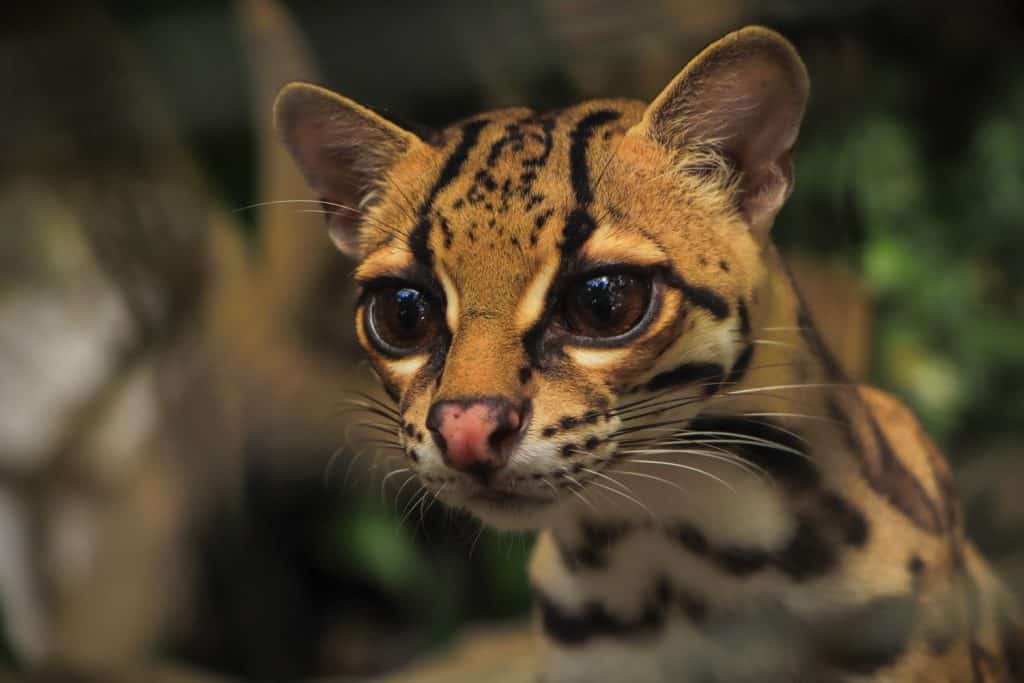
Our Cat Tyga Is the First Leopardus Tilcayo Documented in the United States
Austin Siamese Rescue is a small volunteer-run rescue organization based in Austin, Texas. We take in cats in need and find them the right homes — usually Siamese mixes and related breeds. A few weeks ago, Tyga came into our care after his family moved to the U.S. from Bolivia. We couldn't figure out exactly what species he was — he looked unlike any cat we'd seen. He was smaller than a typical housecat, with a scrunched face, short rounded ears, long whiskers, and a spotted coat covered in rosettes larger than you'd expect. We kept him in our care, but held off on listing him for adoption. Something felt different about Tyga, and we wanted to know what.
Then yesterday's National Geographic story changed everything. After seeing the newly described Leopardus Tilcayo species, we immediately noticed the resemblance and reached out to Bolivian biologist Paola Nogales-Ascarrunz with photos and videos of Tyga.
Further testing confirms Tyga as L. Tilcayo — making him the second known individual of the newly described species in the United States.
We plan to keep Tyga under our care and will not be letting him up for adoption anytime soon.
The Discovery: How Science Named the Tilcayo
In 2016, Paola Nogales-Ascarrunz, a biologist and National Geographic Explorer working in Bolivia, received a call from a local wildlife sanctuary that had just taken in what they described as "a weird cat." It came from a local man who found it as a kitten on a road near a forest. The man took the animal home, believing it to be a domestic breed. But after about a year of living with the clearly wild animal, he realized it would be better off at a sanctuary.
As the lead scientist and founder of the Bolivian Felids Research Program, Nogales-Ascarrunz was intrigued. The animal had a small, scrunched-up face, short and round ears, and long whiskers. It was too small to be a housecat, and, most notably, it was covered in leopard-like spots. So she went to visit the creature at the Senda Verde wildlife sanctuary on the subtropical flank of the Bolivian Andes.
"I took a hundred pictures of it," remembers Nogales-Ascarrunz. "I was so fascinated."
What she couldn't know at the time was that this curious cat had a secret. It would become the first new species of felid discovered in over 100 years, according to a study published in the journal Current Biology. Not a validation of a species proposed in the distant past, nor a previously recognized subspecies raised to species status — this cat was something entirely new to science.
"Our world is extremely complex. Sometimes we think that most of it is known, that there's not a whole lot to discover, but in fact, it's the other way around."— Paola Nogales-Ascarrunz, National Geographic Explorer & co-lead author
A Decade-Long Mystery
At first, Nogales-Ascarrunz assumed the unusual cat was a member of the species Leopardus tigrinus — sometimes called tigrinas, oncillas, tigrillos, or little spotted cats — presumed to exist across Central and South America, including Bolivia. But in 2019, while preparing a booklet about Bolivia's cat species, she realized the cat she'd photographed didn't match reference photos from neighboring Brazil. The rosettes were dramatically larger. "This is so wrong," she thought.
Working with Eduardo Eizirik, a geneticist at Pontifical Catholic University of Rio Grande do Sul, and co-lead author Jonas Lescroart from the University of Antwerp, the team applied advanced genomic analysis. What they found placed the Bolivian cat clearly apart from all known lineages — a distinct branch on the cat family tree, separated for millions of years.

National Geographic Explorer Paola Nogales-Ascarrunz stands near the cat she first encountered a decade ago. She is co-author on the paper that establishes it as a new species.
Fernando Faciole / National Geographic Society
One Species Becomes Five
The researchers propose the cat be known as Leopardus Tilcayo, honoring the name local communities in Bolivia's Yungas region have always used. When Nogales-Ascarrunz asked residents why, the answer was simple: "My grandpa called it Tilcayo, so I call it Tilcayo." The etymology is lost to time.
What was once assumed to be a single widespread species has, through genetic scrutiny, fractured into a complex of distinct lineages. In 2013, scientists showed that Leopardus tigrinus was actually two species. A 2024 proposal added a third. Now this study makes five recognized tiger cat species — and also documents a new subspecies from Peru, Leopardus tigrinus antisuyo.
James Sanderson, founder of the Small Wild Cat Conservation Foundation, noted the findings also hint that the margay — long considered one species from Mexico to Argentina — may be four distinct species. The study carries direct conservation consequences: each newly separated species occupies a smaller range and a smaller population than the old combined count. "Once three species become five species, each population is reduced," Sanderson says. "Conservation efforts must increase, perhaps urgently."
"It's by no means a stretch of the imagination that the improved methods used in this study will reveal new species of small wild cats in Africa and Asia."— James Sanderson, Small Wild Cat Conservation Foundation

The first known Leopardus Tilcayo at Senda Verde Animal Refuge in Bolivia's Yungas region. What the species eats, how it breeds, and how many remain in the wild are almost entirely unknown.
Joel Sartore, National Geographic Photo Ark
For Nogales-Ascarrunz, who spent a decade chasing a hunch about one odd animal at a roadside sanctuary, the formal naming is both a conclusion and a beginning. "Even in the cats, there are things out there that are undescribed, things that people haven't found yet," she says. "So let's go out and find them and protect them."
eople haven't found yet," she says. "So let's go out and find them and protect them."